.png?width=700&name=Copy%20of%20Blog%20header%20(1).png)


In most of the organizations I meet, I typically encounter one of these three video collaboration scenarios:
First, there are the “all-in on Teams” organizations, the ones who either have legacy video conferencing hardware and they need it to work with Teams, and increasingly, the ones who are transitioning to Microsoft Teams Rooms, investing heavily in a unified experience for employees.
Next, there are the merged enterprises, the companies in which years of acquisitions have left a patchwork of collaboration habits, whether it’s Teams in one department and Zoom in another, and/or a mix of systems that all claim to be standard.
Finally, there are the loyal Google Workspace customers, whose people live in Meet but are constantly invited to Teams calls with partners and suppliers.
I’m guessing that at least one of these sounds familiar. But despite the differences in the tools, the reality in all three is the same: no matter how much you consolidate internally, the rest of the world isn’t always going to follow your plan. Solving this requires an interoperability layer to remove limitations from your meeting environment.
The multi-platform reality we live in
Omdia’s latest research shows that half of all enterprises use between two and four collaboration platforms. Microsoft Teams leads globally, Zoom remains strong, and Google Meet and Webex each maintain a loyal following.
Running multiple collaboration platforms simultaneously only drives up cost and confusion. There are many organizations that still pay for both Teams and Zoom, believing it’s the only way to stay connected. Yet removing a platform entirely isn’t realistic when customers and partners use different tools.
On paper, standardizing on one platform seems like progress. In practice, it creates friction. Teams Rooms can’t natively join Zoom meetings, Google Meet Rooms can’t easily join Teams, and certified devices often run only one room client at a time. These limitations turn expensive meeting rooms into single-purpose spaces, making people default to their laptops instead. In fact, around 37% of organizations rely on a bring-your own-device (BYOD) to meetings rooms model, according to Omdia’s survey.
Make every room usable with built-in interoperability
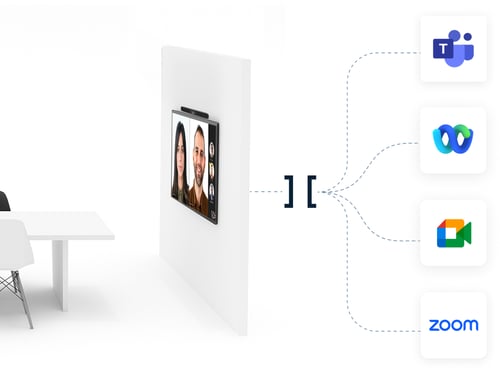
From where I sit, the better approach is to choose one primary platform and add a built-in interoperability layer to connect with everyone else. It removes the need for duplicate licensing, avoids the pitfalls of BYOD, and makes every room fully usable, regardless of who’s hosting the meeting.
Omdia ranks interoperability as the second-largest pain point in multi-platform environments. Since multiple platforms are here to stay, success depends on making collaboration between all of them simple and reliable – so-called universal interoperability – which is exactly what we’re working towards.
At Pexip, we aim to close the gaps between different tools, connecting legacy room systems with modern platforms like Teams and Google Meet through our interoperability solutions, and ensuring that native rooms can do the same. Our goal is simple: every room, every platform, one seamless experience for participants, and no more frustration for meeting goers.
What it means for IT leaders
Even if you consolidate on one meeting platform, your wider ecosystem won’t. The future of collaboration depends on making those connections effortless and intuitive.
When interoperability is built-in, people connect without friction, technology fades into the background, and every room becomes a space where people can collaborate, giving you the value you aimed for.
At Pexip, we believe every meeting room should connect to every platform, keeping the focus on what matters most: people communicating, deciding, and moving forward together.
Want to read the full Omdia Research report on interoperable meeting rooms? Check it out here.
- Enterprise
- Connect