

For many public sector organizations in Europe, digital sovereignty has moved from policy discussion to action item. Sensitive conversations are happening online and on video every day, from court hearings and healthcare consultations to defense coordination and cross-agency decision-making. That makes having trust in where data lives, who controls it, and which laws may still apply high on the public sector agenda.
At first glance, the answer seems simple: host the data in Europe. But in reality, it’s not always as straightforward as it sounds.
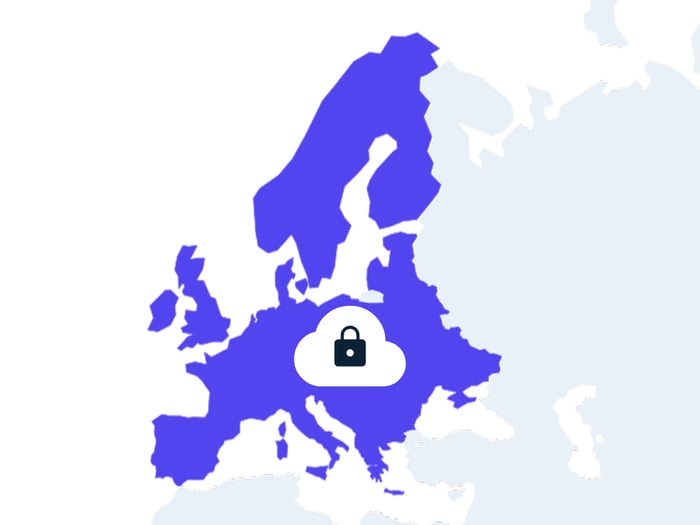
So does hosting data in Europe make a service sovereign? No, not on its own. A service can be hosted in Europe and still fall under non-European law, be operated by a foreign-controlled entity, or depend on external infrastructure. Sovereignty depends on legal jurisdiction, operational control, and who ultimately governs the data — not location alone.
Hosting data in Europe doesn’t automatically make a service sovereign
A service can be hosted in Europe and still fall under non-European laws, which is the reason Schrems II and the fall of Privacy Shield reshaped how Europe treats cross-border data. That is why the conversation has moved beyond data residency to legal jurisdiction, governance, and operational control."For organizations handling sensitive information, they need to understand who ultimately has authority over that data, who operates the environment, and how dependent the service is on external infrastructure.
This is where many “European cloud” offers fall short. They may be accurate about location but not necessarily control. And control is what sovereignty depends on.
Data residency vs data sovereignty: what's the difference?
Data residency is about where data physically sits. Data sovereignty is about whose laws and control govern it. You can have residency (data in an EU datacentre) without sovereignty (the operator, or its parent, is subject to foreign law). Sovereignty is residency plus legal jurisdiction, operational control, and governance.
Under laws such as the US CLOUD Act, a provider subject to US jurisdiction can be compelled to hand over data even when it is stored in Europe, which is why residency alone doesn't guarantee sovereignty.
Video collaboration raises the stakes because conversations are often sensitive
This matters even more in video collaboration. In public sector environments, video is a key service supporting critical conversations where confidentiality, identity assurance, and resilience all matter. A ministry discussing a sensitive issue, a judge overseeing a remote hearing, or a defense team coordinating across locations all need more than a platform that is simply hosted nearby. They need confidence that the meeting environment itself is governed in a way that aligns with their legal, security, and operational requirements.
So when is a European cloud sovereign?Buyers should look past labels and ask how much control they really have
So, what should organizations look for? A good place to start is with a few practical questions:
- Can the solution be deployed and operated in your own environment?
- Does it reduce exposure to foreign jurisdiction and third-party dependencies?
- Do you control access, data flows, and operational governance?
- Can it support sensitive collaboration without forcing trade-offs that weaken usability or interoperability?
A European cloud can be sovereign when it removes exposure to foreign jurisdiction, for example, an ANSSI SecNumCloud-qualified provider such as Bleu + Pexip, operated under French control. The test isn't the "European" label; it's whether the legal, operational, and technical control genuinely sits with you.
The real test is whether you can run critical communication on your own terms
Digital sovereignty is not defined by geography alone. It is defined by control, and by the ability to run critical communication in a way that meets your specific needs. For organizations across government, justice, and defense, this is the real test of whether a collaboration solution is truly sovereign.
.png?width=408&name=Digitale-Souveranitat-Guide-thumbnail%20(1).png)
- Government
- Secure collaboration
- Secure Meetings