This places a different set of requirements on the collaboration platform.
In defense, a video platform must be assessed as part of the operational communications stack.
For procurement teams, the core question is whether the video platform can operate as mission infrastructure. This means working in degraded, disrupted, intermittent, and low-bandwidth (DDIL) conditions; across legacy, coalition, and mission systems; enforcing access by identity attributes, classification, and policy; and remaining under mission-owner control in sovereign, private, or air-gapped environments. A defense-grade collaboration platform must be able to support secure decision-making without becoming another point of operational friction.
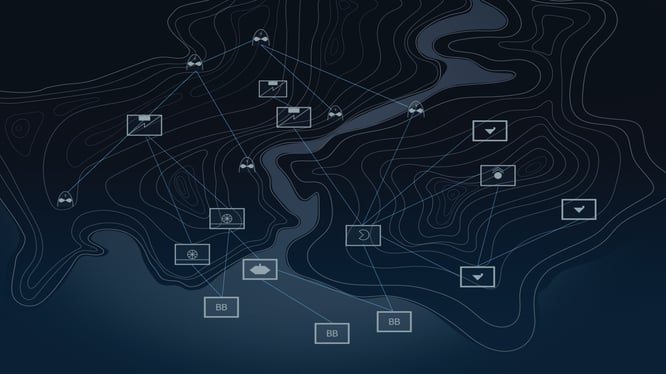
Modern conflict is driving more dispersed command models.
The conflict following the full-scale invasion of Ukraine has raised the technical bar for video in mission environments. Never has the need to span any platform, device, or network been so vital on the battlefield. Smaller, distributed units operating under constant drone and long-range strike threats in high electromagnetic threat environments must rely on real-time video to stay connected with command structures. The ability to deliver resilient video services over both military communication networks and fixed civilian infrastructure (spanning fixed fiber, mobile technology, and commercial satellite) in a layered multi-bearer battlefield network is essential. The platform must function in low-bandwidth, high-latency, and degraded environments while remaining usable across dispersed users and changing network conditions.
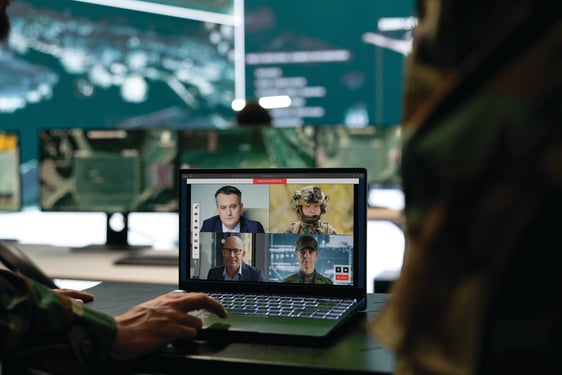
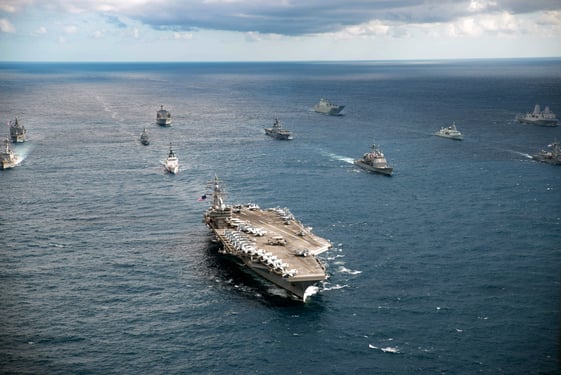
Data-centric interoperability in action: Operation HIGHMAST
During Operation HIGHMAST, the recent high-profile mission led by the UK Carrier StrikeGroup (CSG), video was used to support mission planning and exercise coordination, giving the multinational task force a reliable way to work together across allied networks. HIGHMAST also highlighted the operational value of a data-centric approach, where security, policy, and releasability stay attached to the information itself. In coalition operations, where access requirements change constantly across classifications, national boundaries, and mission roles, that approach offers a more flexible and scalable way to share information securely.
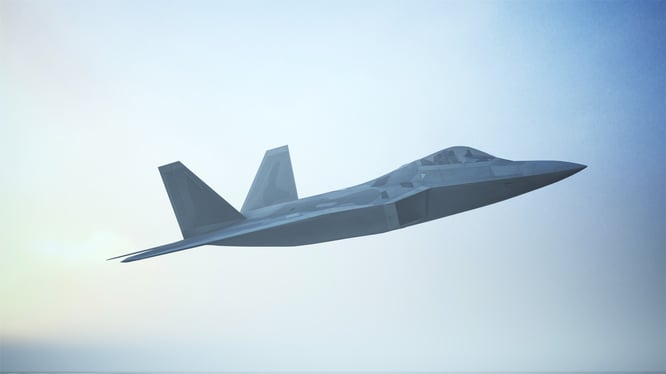
The UK Global Combat Air Program (GCAP) is a strong example.
A huge number of suppliers may be responsible for different parts of a complex aircraft development project in a program like the GCAP, but they still need to work off the same designs, align decisions, address risk, and move forward together. In practice, that means engineers and stakeholders in different locations may need to stay on a secure video call while viewing or manipulating design data in real time. That places a much higher burden on collaboration technology than a standard enterprise meeting does.
This challenge extends beyond unauthorized access to a meeting.
In some cases, that requires self-hosted deployment. In others, sovereign private clouds or air-gapped environments are necessary. The world’s leading hyperscaler cloud providers are increasingly promoting their services as relevant to secure workloads, something most people thought impossible a few years ago. The common requirement is that the collaboration model must match the security and contractual demands of the program, often requiring purpose-built solutions to support these complex contexts.
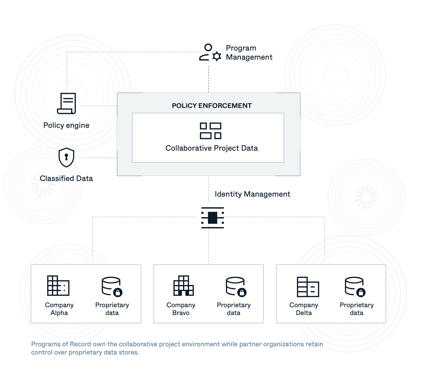
When integrated properly, secure video delivers clear operational value in this environment.
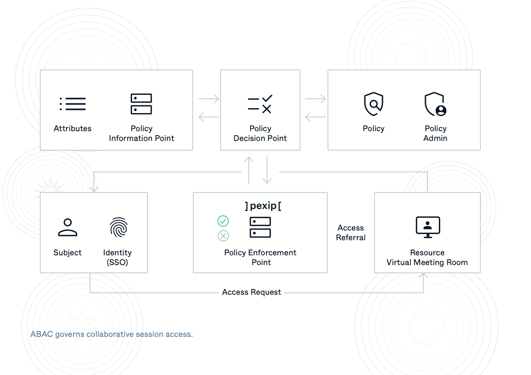
It can shorten engineering review cycles, reduce unnecessary travel, help protect intellectual property, improve coordination across partners, and support faster program alignment. In sensitive settings, that value also depends on the surrounding collaboration ecosystem. Additional safeguards such as deepfake detection can help reduce the risk of impersonation or synthetic media in high-trust conversations, while AI controls can support real-time assistance without exposing sensitive data to public models. This makes open architecture and secure integration increasingly important where collaboration spans multiple systems, partners, and security requirements.
The third scenario is defense enterprise collaboration.
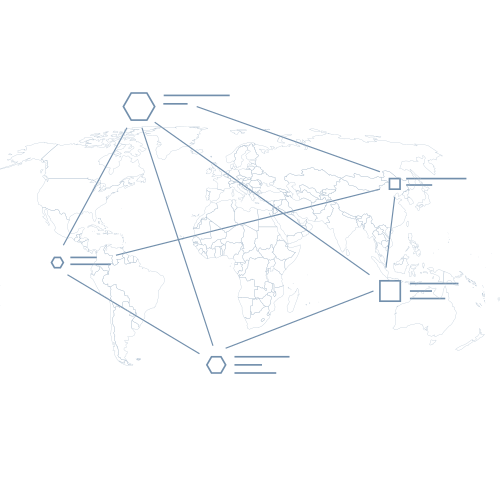
That makes defense enterprise collaboration fundamentally different from a typical commercial environment.
In this scenario, video supports secure coordination across headquarters, commands, crisis-response functions, and distributed teams. This may include leadership communication, operational planning, secure internal briefings, and cross-site collaboration in environments where reliability, access control, and auditability all matter.
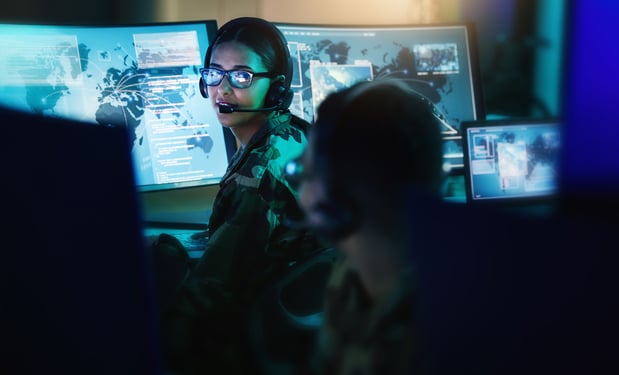
What all three scenarios have in common
Mission collaboration, defense industrial collaboration, and defense enterprise collaboration each have a unique set of challenges. But the closer you look, the more their requirements converge.

The platform must be resilient.
In defense, resilience means more than service uptime in a normal office environment. It means supporting degraded conditions, low-bandwidth scenarios, distributed architectures, and operational environments where a single failure cannot be allowed to disrupt communication.

It must be secure by design.
Encryption matters, but it is only one part of thepicture. Defense environments also require strong identity controls, policy-based access, least-privilege enforcement, clear classification handling, and fullauditability. Increasingly, they also require a data-centric security approach, where access is governed by identity, attributes, classification, and policy rather than by network location alone.

It must be interoperable across technology and international boundaries by default.
Defense organizations cannot assume a single platform, a single endpointtype, or a single network model. Interoperability has to extend across legacy VTC, modern collaboration systems, mission applications, partner environments, and coalition structures.

It must be deployable under mission-owner control.
Defense organizations need the freedom to choose where the system runs, how it is governed, how it is updated, and how it integrates into wider security architecture. That control is increasingly important in a world shaped by sovereignty demands, zero-trust principles, and supply-chain risk.
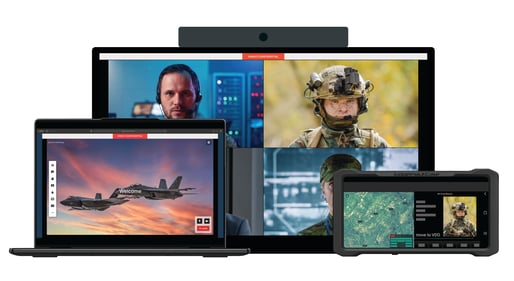
Pexip supports all three defense scenarios through a combination of deployment flexibility, interoperability, and mission-owner control.
Defense customers rarely have the option of starting from scratch. They need a platform that can work across legacy video teleconferencing (VTC), modern platforms, mission applications, and varied endpoint types. In mission environments, that extends to support for FMN-aligned interoperability and integration into command-and-control and wider command, control, communications, computers, intelligence, surveillance, and reconnaissance (C4ISR) environments.
Pexip can be deployed on premises, in private or sovereign cloud environments, or in air-gapped settings where required.
Built on operational experience
.png?width=500&name=Copy%20of%20Blog%20header%20(7).png)
Nick Ross
- 10+ years UK Armed Forces
- Specializes in bridging operational realities and critical communication
.png?width=500&name=Copy%20of%20Blog%20header%20(8).png)
Mel Green
Defense & Intelligence specialist, Pexip
- 25 years+ British Army officer
- Extensive experience in operational planning and intelligence
- MSc in Modern Warfare

Joel Bilheimer
Head of Strategic Federal Programs & CISO for Pexip Americas
- 20 years of experience supporting the US DoD in video teleconferencing and cybersecurity.
- CISSP and CCSP certifications from (ISC)2.