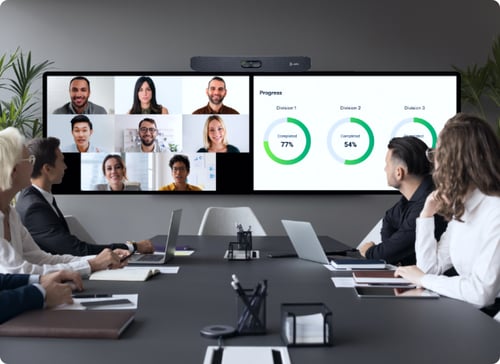
Deepfake attacks are becoming harder to recognize and easier to execute. Attackers can now create convincing video meetings using synthetic faces and voices, manipulated footage, and other social engineering techniques.
Read more about the increased threat to deepfake attacks in video meetings.
For video conferencing, that changes the security equation. If you can’t rely on appearance alone to establish trust, how do you make sure the right people are actually in the meeting?
For me, the answer starts with identity and access control. Deepfake detection can provide an additional layer of assurance, particularly for high-risk conversations. But organizations can also make impersonation much harder to turn into unauthorized access by verifying identity and controlling what each participant is allowed to access.
How authentication and authorization can mitigate deepfake risk
Authentication and authorization serve different purposes, and both matter when protecting sensitive video meetings.
Authentication verifies identity before access
Authentication establishes that a participant is who they claim to be before they are admitted to a meeting. Rather than relying on other participants to recognize a face or voice, identity can be verified using controls such as:
- Multi-factor authentication (MFA): Requires more than one form of verification before access is granted.
- Single sign-on (SSO): Allows participants to authenticate through an organization’s existing identity provider.
- Digital certificates: Can authenticate trusted devices and participants.
- Biometric verification and liveness detection: Can provide additional identity assurance by helping verify that a participant is genuinely present and not an impersonated or synthetic identity.
The appropriate level of authentication should match the sensitivity of the conversation. A routine internal meeting does not require the same controls as a board meeting, defense briefing, or discussion involving highly sensitive information.
Authorization controls what a verified identity can access
Authentication alone doesn’t answer every security question. A participant can be exactly who they claim to be and still lack permission to join a particular meeting or access certain information.
Authorization adds that next layer of control.
Organizations can apply authorization in different ways:
- Role-based access control (RBAC) grants access based on a participant’s established role and responsibilities.
- Attribute-based access control (ABAC) can make more granular decisions based on factors such as security clearance, organization, nationality, location, or mission assignment.
In the context of deepfakes, this means security doesn’t have to depend on someone in the meeting deciding whether a face or voice seems genuine. Access can be based on verified identity, permissions, and context instead.
Where zero trust fits
This approach aligns naturally with Zero Trust, which means every access request should be verified rather than assuming that a user or device can be trusted because of where they connect from.
For video meetings, that involves verifying the participant, determining whether they should have access to the session, and applying the appropriate permissions. For higher-risk environments, policies can also be reevaluated as the context of a session changes.
Learn more about Zero Trust for video communications.
Layer security according to the risk
There is no single control that eliminates the threat of deepfake attacks. The appropriate safeguards depend on what is being discussed and the consequences if an unauthorized participant gains access.
Beyond identity and access controls, organizations can add further safeguards based on the level of risk:
- One-time or expiring meeting links: Reduce the opportunity for meeting credentials to be reused.
- Audit logging: Creates a record of access decisions and session activity.
- Self-hosted or air-gapped deployment: Gives organizations greater control over infrastructure, data, and access policies where security or sovereignty requirements demand it.
The principle is simple: the greater the consequence of unauthorized access, the stronger the layers of identity assurance and access control should be.
Build trust into the meeting
Deepfakes will continue to get harder to spot, and security teams shouldn’t have to win a visual guessing game every time someone joins a sensitive meeting. Building security into how participants gain access gives organizations a more resilient way to protect important conversations as the technology evolves.
This is the foundation of modern access control for video, where the right people can access the right conversations under the right conditions.
Originally published November 25, 2025

- Healthcare
- Judicial
- Government
- Defense
- Enterprise
- Secure collaboration
- Secure Meetings