Krankenhaus Märkisch Oderland
With Pexip Märkisch-Oderland Hospital achieved :
Secure, centrally managed video collaboration
across three hospital sites
Full data sovereignty
under European regulation and without backdoors
A consistent user experience
across rooms, PCs, and mobile devices - in the hospital’s branding
Reduced IT workload
and faster clinical coordination
Challenges
Märkisch-Oderland Hospital serves patients across three locations in Germany: Strausberg, Wriezen, and Seelow. As care delivery and regulatory requirements evolved, the hospital faced growing demand for virtual collaboration among clinicians, administrators, and external partners.
Hospital leadership identified several constraints:
- Clinicians and staff needed dependable video communication that complied with strict German and EU data protection rules.
- Existing tools lacked central control, making governance and oversight difficult.
- Collaboration technology needed to work seamlessly on room systems, desktops, laptops, and mobile devices.
- The solution had to support multi-site workflows without introducing complexity for users or IT.
We did not want a patchwork of isolated solutions, but a consistent experience, whether in a conference room, a doctor’s office, or working remotely.
Märkisch-Oderland Hospital
Challenge
Need to facilitate communication between 6 intercommunal bodies bringing together the territory's 92 communes and their internal & external contacts. Replacement of Bluejeans' video interoperability service in 2023.
Results
Secure, flexible and easy-to-use cloud service. Operational stability and guaranteed quality of service. User satisfaction: easy connections from video meeting rooms and/or Microsoft Teams.
Solution
Pexip interoperability solution with interconnection to Microsoft Teams.
Pexip services used
Pexip Connect standard: with gateway (CVI) to Microsoft Teams.
Pexip solutions
Märkisch-Oderland Hospital selected a self-hosted Pexip video collaboration platform to meet its security, interoperability, and operational needs:
- Self-hosted deployment for data control and compliance
- Cross-device support across conferencing room systems, PCs, and mobile
- Centralized administration and scalability across locations
Why Pexip
The hospital’s IT leadership evaluated multiple options against strict privacy, security, interoperability and usability criteria. The assessment focused on solutions that could deliver on-premises control, clear governance, and consistent user experience across devices, without adding operational complexity for users or IT.
Pexip was selected for its security architecture, configurability, and ability to align with the hospital’s technical and clinical workflows. Implementation was carried out in close collaboration with the local partner AVN Solution GmbH to ensure the solution was fully integrated into the hospital’s infrastructure.
We didn't just want to be prepared for today's challenges, but also for whatever might come next.
Märkisch-Oderland Hospital
Results
A unified communication platform
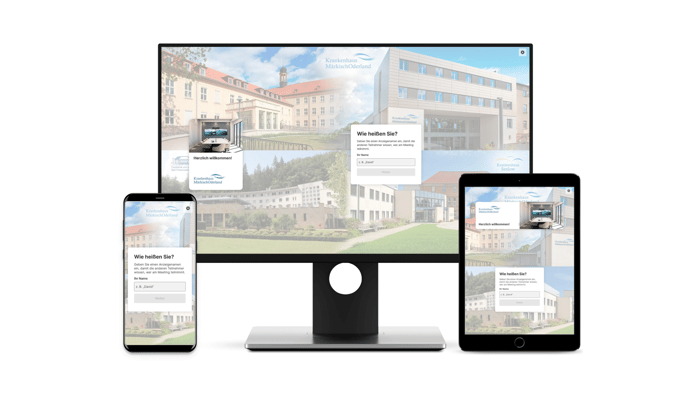
The hospital now operates one secure platform across all three sites. Clinicians connect consistently across room systems, desktops, and mobile devices. Joining via the Poly room systems is seamless with “One Touch Join,” while participants can also connect directly through their browser using WebRTC. The result is end-to-end interoperability combined with a consistent, hospital-branded interface aligned with the organization’s corporate design.
Reduced IT workload
Departments schedule their own meetings, significantly reducing reliance on IT. Technical teams can focus on infrastructure and governance.
Stronger clinical coordination
The platform supports tumor boards, hybrid collaboration, management meetings, and external consultations, all within one protected environment.
Less travel, faster decisions
With sites located 30 to 40 minutes apart, teams collaborate without unnecessary travel. Decisions are made more quickly across locations.
Ready for structural change
As hospital reform reshapes services and specialization, the hospital has now a secure and easily scalable communication infrastructure that supports continued transformation.
About Märkisch-Oderland Hospital
Märkisch-Oderland Hospital provides primary inpatient care across three locations in the Märkisch-Oderland district in Germany. Its services range from general, trauma, and orthopedic surgery to internal medicine, gynecology, obstetrics, rehabilitation, and specialist practices. The hospital’s networked care model relies on robust collaboration tools to connect clinicians and support teams across distinct campuses.