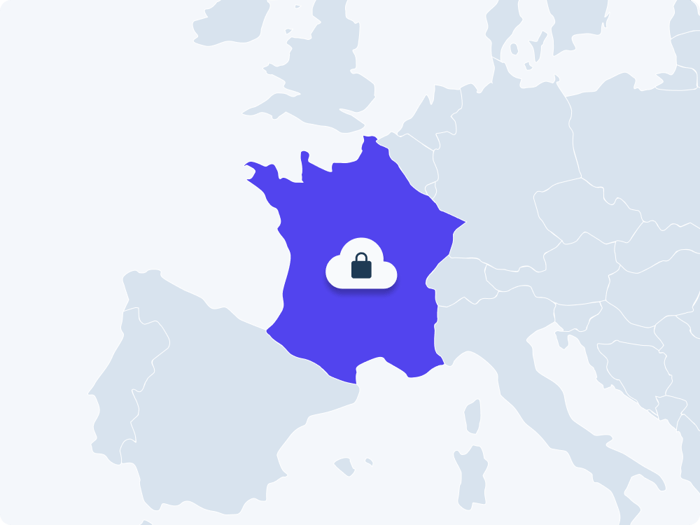


Across the French public sector, something has shifted. Ministries and large public organizations are being asked to assess what it would take to reduce dependence on non-European technology. In some cases, that means making plans to move away from widely used tools and platforms. The change won’t happen overnight. But it does signal a clear direction for the future.
A stronger push from the center
France's digital authority, La Direction Interministérielle du Numérique (DINUM), has clarified its "Cloud au Centre" doctrine for public sector IT procurement, encouraging the use of trusted European solutions and greater control over critical systems. At its core, the doctrine steers sensitive public data toward hosting that carries ANSSI's SecNumCloud qualification — the French benchmark for a genuinely trusted, sovereign cloud. This is already reshaping the market: Pexip's secure video meetings are, for example, available on Bleu's SecNumCloud-aligned trusted cloud, the French provider founded by Capgemini and Orange. At the same time, ANSSI continues to set expectations around security, risk management, and sovereignty for government systems.
And these conversations are no longer just happening between IT teams. It is being led at ministerial level, with clear expectations around independence, resilience, and long-term control.
From cloud convenience to control and continuity
For years, major global cloud platforms have offered simplicity, scale, and a familiar user experience, expectations that are certainly not disappearing. French public sector organizations still want tools that are easy to use, feature-rich, and cost-effective.
But there is growing awareness that convenience can come with trade-offs. Legal jurisdiction, dependency on external providers, and the risk of disruption are now part of the evaluation. Recent discussions in the market have even explored “blackout scenarios,” where access to critical services could be restricted or interrupted.
That has changed the tone of the conversation. The focus is shifting from what works today to what can be relied on over time, for the long-term.
Open source is part of the answer, but not the whole system
France has long supported open source, and that momentum is growing. National initiatives are promoting collaboration tools built on open technologies, often in partnership with other European countries.
Open source brings flexibility and transparency. It gives organizations more control over how systems are built and deployed. But components are not the same as a complete system.
Open source and sovereign collaboration: who carries the responsibility?
Running a collaboration environment at scale requires ongoing responsibility. Integration, updates, security, and compliance do not disappear. They need to be managed, either internally or by a vendor that takes accountability for the full solution. Building on an open-source solution doesn’t mean you have the resources to support it in the long term.
For many public sector organizations, that balance is still being worked out.
Why this matters for collaboration and video
What we see is that public sector organizations are not looking for a standalone meeting platform. They are looking for a sovereign collaboration environment that can support messaging, file sharing, and video within their own constraints. Video becomes one part of a larger workflow, often tied to specific use cases such as secure communications, air-gapped environments, or cross-agency coordination.
That is where flexibility comes into play. The ability to integrate into existing systems, support different deployment models, and operate within strict security requirements becomes more important than any single feature.
A shift that is still taking shape
France has been investing in sovereign technology for years. What is different now is the pace and the level of coordination. There is clear political backing, growing market demand, and a stronger ecosystem of European providers making locally-sourced a valid option.
At the same time, expectations remain high. Public sector organizations need solutions that are reliable, easy to use, and sustainable over time. They are cautious about replacing one dependency with another or adopting tools that cannot be maintained in the long run.
That is why I don’t see this transition as defined by a single decision. It will be shaped by how well new approaches can deliver control without adding complexity, and how they support the critical conversations that public services rely on every day.
- Government
- Secure collaboration
- Secure Meetings
%20header.jpg?width=500&name=Secure%20meetings%20Pillarpage%20(primary%20solition)%20header.jpg)