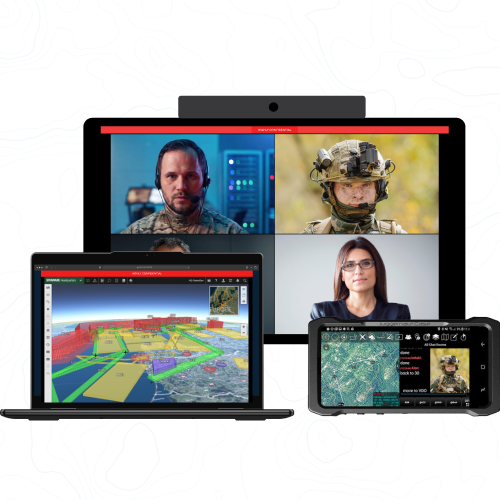


The ability to communicate has always shaped military operations. What has changed in modern warfare is the sheer volume of operational data, from signals intelligence and logistics information to sensor feeds, that must move across multiple domains, often between allies using different networks. Today, maintaining secure, resilient communications from strategic headquarters to dismounted soldiers in the field is critical to mission success.
What are the main types of military communication systems?
Modern military communications combine voice, data, video, and network infrastructure to support command and control (C2) across land, air, maritime, space, and cyber domains. These capabilities operate across multiple interconnected systems, each with different operational requirements.
- Tactical radio and voice: Combat net radios and push-to-talk systems provide immediate communication between deployed units across the battlespace.
- Tactical and beyond-line-of-sight networks: Satellite communications (SATCOM), tactical wireless, and other transport networks connect mobile command posts, vessels, and remote locations.
- C2 and data systems: Battle management applications exchange operational information, including intelligence, orders, and situational awareness data.
- Video and content sharing: Secure video meetings, screen sharing, and other visual information sources support remote briefings and coordination between command elements.
As data moves across the mission via platforms and networks, interoperability and security are non-negotiable. In joint and coalition operations, NATO Federated Mission Networking (FMN) provides a framework for information exchange between allied forces, while data-centric security approaches help protect sensitive information as it moves between systems and security domains.
How are modern military communications evolving?
Many aspects of military communications are moving toward common, open-architecture IT platforms as defense organizations seek to reduce the complexity of fragmented, custom-built systems. These shared foundations make it possible to integrate voice, video, and content sharing directly into C2 and battlespace management applications. Operators can access collaboration capabilities within their existing mission systems rather than context switching or moving between separate tools.
How do military communications operate in DDIL environments?
At the tactical edge, military communications must function in denied, degraded, intermittent, and limited bandwidth (DDIL) environments. Deployed forces cannot depend on continuous cloud connectivity or access to centralized data centers. Communications infrastructure may need to operate locally, including in air-gapped environments on ruggedized hardware powered by vehicles, ships, or field generators.
How does secure video support military communications?
Secure video brings an important human dimension to military command and control. In high-stakes situations, seeing the people you’re communicating with provides valuable nonverbal cues, builds trust between teams, and helps commanders make more informed decisions. Video also allows personnel to share live operational information, including intelligence, surveillance, and reconnaissance (ISR) feeds, so they can assess situations together in real time.
While secure video has long supported collaboration at headquarters and operational command centers, bringing these capabilities to the tactical edge has been far more challenging. Limited bandwidth, disrupted connectivity, and the demands of deployed environments have traditionally restricted its use. That is no longer the case.
Pexip provides a self-hosted video collaboration platform designed for strict data control, zero-trust and data-centric security, and NATO FMN interoperability. Defense organizations can deploy Pexip on infrastructure they control, including air-gapped environments.
With Pexip, defense organizations can:
- Connect coalition partners securely. Bridge different vendor platforms, technologies, and classification domains to enable video, audio, and content sharing across federated networks.
- Bring live ISR into collaboration. Integrate sensor and unmanned aerial system (UAS) feeds into video sessions so commanders can assess real-time visual information alongside other operational data.
- Scale from strategic headquarters to the tactical edge. Deploy the same collaboration platform across permanent headquarters, operational command centers, and deployed tactical nodes, simplifying administration and training.
Explore Pexip for Defense products here.
How Pexip and MilDef are bringing secure video to the tactical edge
Pexip's partnership with MilDef, a leader in ruggedized military IT, shows how secure video is now viable in tactical environments where it has traditionally been difficult to deploy.
MilDef's OneCIS tactical IT platform uses Infrastructure as Code (IaC) to automate the deployment and configuration of command-and-control (C2) and battlespace applications on compact, ruggedized hardware. Traditionally, configuring these systems could take weeks and require specialized technical personnel. With Pexip integrated into OneCIS, military units can deploy a fully configured, air-gapped tactical node with secure video, audio, and content sharing in a single day rather than weeks.
In one European navy deployment, Pexip and OneCIS were used to connect deployed vessels with a maritime command center. By integrating live video and content sharing into existing C2 applications, commanders gained a clearer common operational picture and could make faster, more informed decisions across the fleet.
- Defense
- Secure collaboration
- Secure Meetings