

Making the meeting truly secure begins long before anyone joins the call. Let’s dig into what’s needed to get there.
It’s 8:30 a.m., a hearing begins.
A police officer joins remotely from a secure room. A defense attorney connects from another city. The judge is already present. The case involves classified material. The concerns surrounding this call go far beyond background blur or screen layout. In moments like this, control is everything.
- Where is the video traffic going?
- Who can access this meeting?
- Who controls the infrastructure behind it?
In sectors like defense, government, justice, healthcare, and finance, a meeting isn’t just a meeting. It is a conversation that may involve patient data, financial records, operational plans, or legal testimony. The technology enabling that must be part of the trust model, which means it must be flexible enough to allow organizations to define and enforce their own controls.
Here are five key elements to determine whether your meeting is truly secure.
1. You control who can join.
A meeting is only as secure as its access controls. For organizations operating under Zero Trust principles, trust is never assumed. Every participant must be verified, and their access must reflect their role.
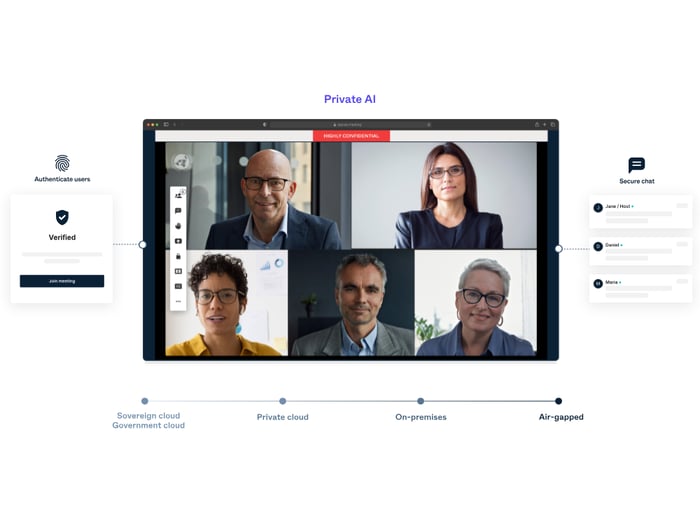
- Multi-factor authentication (MFA) and single sign-on (SSO) ensure that only verified individuals can access a meeting.
- Role-based access gives participants only the permissions they need, whether that’s viewing, presenting, or recording.
- Continuous verification aligned with Zero Trust models validates who is joining, from where, and with what level of privilege.
Read our comprehensive guide to controlling access to video meetings to learn more.
2. You control where your data lives.
In regulated industries, organizations must ensure that meeting data is stored and processed in alignment with certain policies.
- Frameworks such as GDPR, NIS2, ISO 27001, FedRAMP set the standard for secure data handling.
- Use of non-sovereign solutions may mean your meeting data is transferred across multiple jurisdictions, potentially violating compliance policies.
- Deployment flexibility, whether it’s on-premises, sovereign cloud, or a hybrid approach, ensure that you determine where data is handled and under which jurisdiction.
3. You control what participants can do.
Security does not end once someone joins the meeting. It extends to what actions are allowed inside the session.
- Dynamic policy enforcement restricts actions like screen sharing, recording, or external participant access based on security policies.
- Integration with policy enforcement tools like Virtru enable real-time data protection and access control.
4. You control additional safeguards.
For highly confidential discussions, additional protections can make a meaningful difference.
- Secure guest access means external participants should have limited privileges and be closely monitored.
- Watermarking can help deter and trace information leaks.
- One-time meeting links reduce the risk of unauthorized reuse or distribution.
5. You control accountability and proof.
Security is also about demonstrating compliance.
- Highly secure meeting environments provide comprehensive logging and audit trails, so organizations can track who joined, from where, and what actions they took.
- Certifications and third-party audits matter as well. Compliance with recognized standards such as ISO 27001 and FedRAMP provides independent validation that security controls are in place and continuously maintained.
Control defines secure meetings
In everyday collaboration, convenience may be enough. But in defense, justice, government, healthcare, and other regulated sectors, you need more. A truly secure meeting allows your organization to control:
Who joins.
Where data resides.
What participants are allowed to do.
Which safeguards apply.
How security is audited and validated.
When control remains in your hands, video collaboration becomes trusted infrastructure for your most critical conversations.
Read our complete guide to secure meetings here.
- Secure collaboration
- Secure Meetings
.png?width=500&name=Digitale-Souveranitat-Guide-thumbnail%20(1).png)